We will extend the opening hours during the examination period
The following libraries extend the opening hours during the examination period.
The Library of the Graduate School of Letters and Faculty of Letters
Graduate School of Education and Faculty of Education Library
Faculty of Law Library
Library of Graduate School of Economics and Faculty of Economics
The Medical Library
Graduate School/Faculty of Agriculture Library
Yoshida-South Library
The Main Library
Please confirm the detailed opening schedule on "Hours" of the website.
Contact: Kyoto University Library
User Support Division
075-753-2681
[Circulation and Access Services Section 2018.7.4]
[Kyoto University Library Network] Would you become a contributor to our digitization projects? - "Kyoto University Rare Materials Digital Archive Fund" set up
In order to accelerate the digitization of our rare collections, Kyoto University Library Network has set up "Kyoto University Rare Materials Digital Archive Fund".
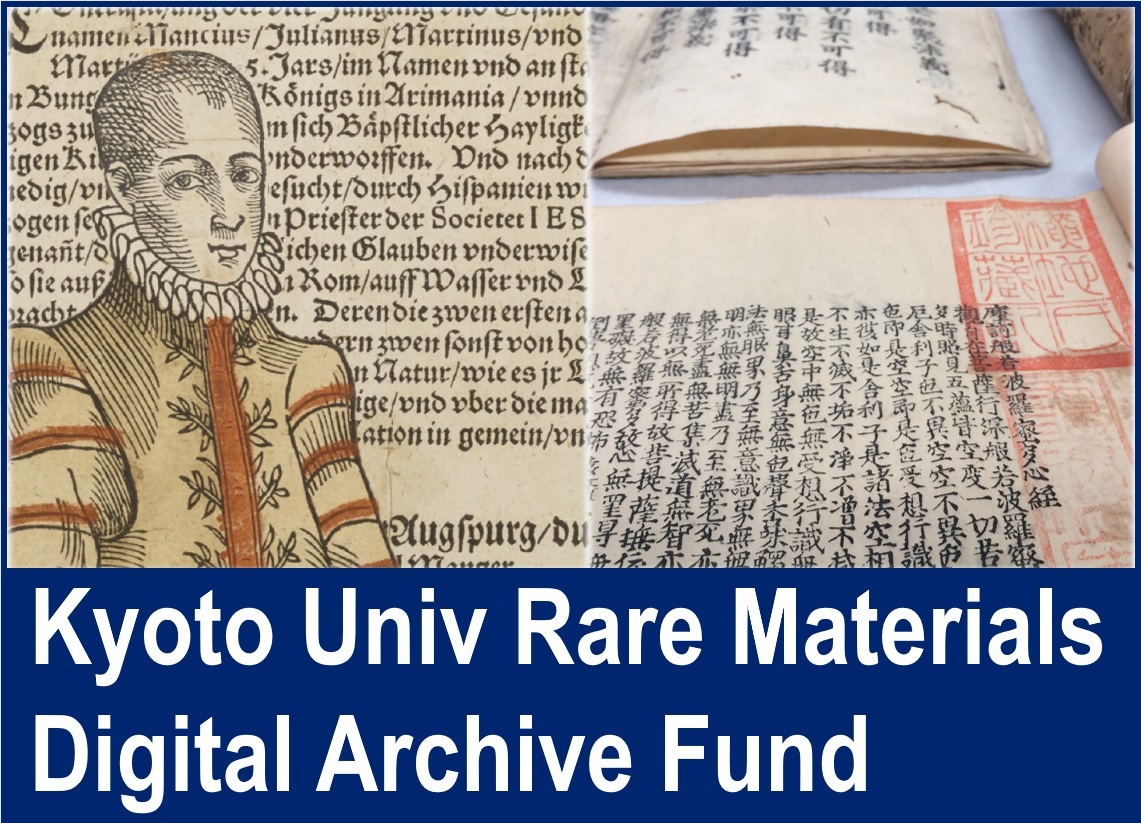
It is one of Kyoto University Library Network's missions to securely preserve the rare book and manuscript collections Kyoto University holds and provide them for the use of researchers, in order to support academic research and contribute to society. As a means to share the information described in these rare materials more widely, Library Network has been digitizing them and making the data available on the internet. You may have seen some of the images, for example, on a history textbook at school or on a tourist brochure when sightseeing.
Many rare materials have become fragile through a long period of time and not everybody can take them in their hand as they want. However, if these rare materials are digitized and open to the public on the internet, we can learn the wisdom of our ancestors described there even at home. Still, many rare materials are waiting to be digitized, because the digitization process requires so much care and cost to restore the damaged part of the rare materials and to take digital photos of them with the utmost care for their physical conditions.
This fund will support the digitization of the rare materials Kyoto University holds and open access to the digitized data in "Kyoto University Rare Materials Digital Archive". The digitized data, as a common property of society, is freely reusable for your creative activities. We hope to contribute to the promotion of academic research and the development of education and culture by digitizing the rare materials handed down to our generation and making them available to the world, while preserving the original materials for future generations.
Your kind understanding and support would be greatly appreciated.
Please refer to this site for detail.
[Maintenance]RefWorks (July 1)
Due to network system maintenance, RefWorks will be unavailable during the following period.
We appreciate your support and patience.
Date: Sunday, July 1, 2018 Time: 08:00-10:00 (JST)
Users will not be able to:
- RefWorks
- Write-N-Cite
- Write-N-Cite for Google Docs (RefWorks Google Docs)
- RefWorks Citation Manager
[Main Library Academic Support Section]
[Library Network] Warning: Large volume access using pre-read browser functions
*For the latest information, see
[Attention!] Regarding Bulk Access to Electronic Resources Due to Automatic Download Features of Reference Management Tools and Browser Preloading Functions
(2024/07/26)
Accessing large volumes of data over short periods of time during use of electronic journals, e-books, databases may be regarded as a breach of contract and thus result in suspension of access to such services for Kyoto University as a whole by their providers.
ref: Conditions of Use and Licensing Restrictions for E-Resources
There have been frequent recent occurrences of users unintentionally downloading or accessing large volumes of data using pre-read browser functions.
Pre-read browser functions continually access links within pages in the background while pages are being viewed. As a result of this, large volume data downloads or large volume access of which the user is unaware may occur, even if the user intends to use electronic journals in the standard way.
We request your cooperation in disabling these functions by making the below changes to your browser settings. Be aware that there have been many reports of this happening with Microsoft Edge in particular.
- Microsoft Edge
- Open Settings > Advanced Settings
- Set "Use page prediction to speed up browsing and improve reading view" to off.
- Internet Explorer 11
- Open Internet Options > Advanced tab
- Under "Browsing" uncheck the box "Load sites and content in the background to optimize performance"
- Google Chrome
- Open Settings > Show Advanced settings
- Set "Use a prediction service to load pages more quickly" to off.
- FireFox
- Type “about:config” in the URL bar and press Enter.
- If the “This might void your warranty” warning is displayed, click "I’ll be careful I promise"
- On the configuration screen double-click "network.prefetch-next" and set to "false."
- Safari (Mac)
- Open “Preferences” from the Safari menu bar
- On the “Search” tab uncheck “Preload Top Hit in the Background”
Electronic Resources Team:
https://www.kulib.kyoto-u.ac.jp/form/14106
[Library Network]
[Institute for Research in Humanities] Taiwan Lectures on Chinese Studies: 6/26 (TUE)
The Digital Humanities in Taiwan: Past, Present and Future
Speaker : Prof. Ping-tsu Chu
(Department of Chinese Language and Literature, National Tsing Hua University, Taiwan ROC)
Time : June 26 (TUE), 10:00-12:00
Venue : Conference Hall, Branch Building, Institute for Reseach in Humanities, Kyoto University
Cosponsors :
- Taiwan (ROC) : National Central Library Center for Chinese Studies
- Japan : Kyoto University
http://www.zinbun.kyoto-u.ac.jp/wp-content/uploads/2018/06/Tawian_Lectures_on_Chinese_Studies-2018_Japan.pdf