Caution Regarding Predatory Journals
Some open access journals have no academic credibility. This is because they only aim to revenue from the article submission charge (APC) and do not conduct proper peer review. They are called "Predatory Journals" and have become a major problem.
If you submit an article to Predatory Journals, it will undermine your research results and credibility, and will have a negative impact on your career in the future. Please choose your submissions carefully.
Check Before Submission & Peer Review
Ask Other Researchers
Ask researchers in the same or similar fields about the journal's reputation and whether involvement with the journal would be beneficial to your research career.
Are there any comments about the journal's quality on social networking sites?
See the Official Website
Google the journal's official website yourself and check it.
Do NOT use a link in invitation email.
Is the period of the peer review too short? Is there anything suspicious about the website logo, such as poor image resolution or a distorted layout?
The website called SciRev enables users to check the total peer review times for individual journals It can be used to get an overall impression of current peer review times.
Reference: The average peer review periods
| Total | First response time | |
| All | 17 weeks | 13 weeks |
| Natural Sciences | 14 weeks | 11 weeks |
| Humanities | 22 weeks | 16 weeks |
Huisman, J., Smits, J. Duration and quality of the peer review process: the author's perspective. Scientometrics113, 633–650 (2017). https://doi.org/10.1007/s11192-017-2310-5 Processed Table 1 and 2.
Read Previous Articles
Read previous articles published in the journal.
Do they match the scope of coverage stated on the official website?
Does the quality of the articles indicate a journal worthy of publishing your own research?
Check the Editor's Profile
Are the editors listed on the official website researchers that you have heard of, or researchers in the field that you want to contribute to?
Does the editor's own official website (e.g. the website of their university) clearly state that he/she is an editor of the journal?
FYI:
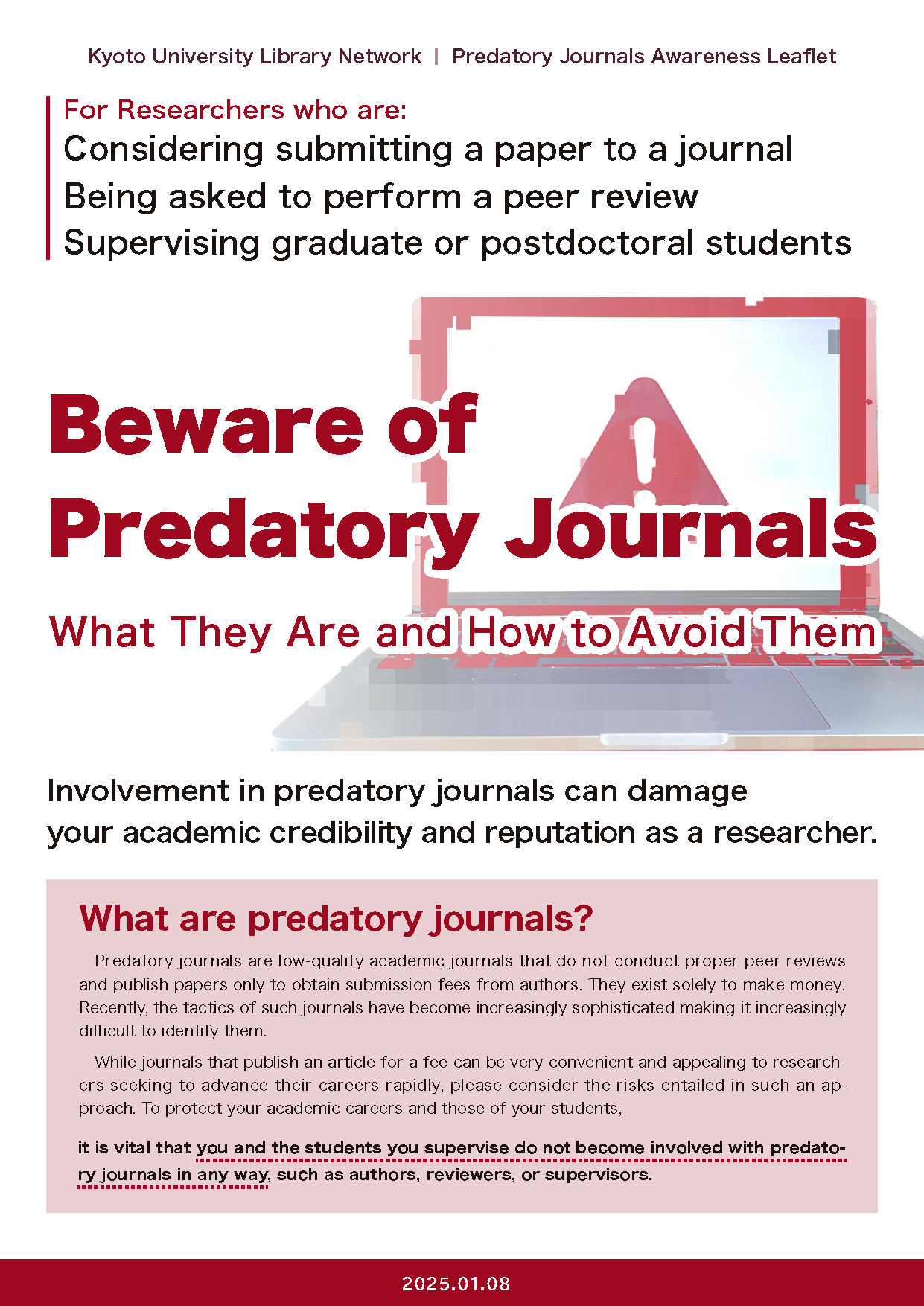
- - Leaflets: "Beware of Predatory Journals" (Kyoto University Library Network, January. 2025.)
- - Jeffrey Beall. "What I learned from predatory publishers" (Japanese Ver. by Kyoto University Library)
Inquiry Form
Kyoto University Library Network provides consultations on journal selection and accepts reports/inquiries regarding questionable journals (Kyoto University members only). If you are unsure about a journal, please contact us using the form below. We will investigate the journal based on criteria such as:
- Review period
- Peer review policy
- Official journal website (e.g., checking for suspicious formatting or errors)
- Presence on blacklists
- Presence on whitelists
etc.
Notes on Service Usage
To ensure appropriate responses and build an institutional case repository, your inquiry and our investigation findings may be shared with your department library and related administrative units. We may also follow up with you for additional details if necessary.
While the Library Network strives to provide objective information based on our investigation findings, the final decision on whether to submit your manuscript rests solely with the author.
Please note that it takes approximately 7 business days (excluding weekends and national holidays) to respond. Depending on the nature of the inquiry, additional time may be required.
▼ Predatory Publishing Consultation Form (Internal access only)
