[Main Library] (PAST POSTS) Preventive Measures against Coronavirus Disease 2019 (COVID-19)

 On 2020-04-21 (4126 reads)

Although we always hope to provide you with the best experience, Kyoto University Main Library currently limits the services and the use of library facilities in order to prevent the spread of COVID-19. We sincerely apologize the inconvenience this may cause and appreciate your kind cooperation.

Updates:

April 7, 2020 - The Main Library to be closed from April 9 to May 6
April 1, 2020 - Urgent Notice Regarding Measures Against the COVID-19
March 27, 2020 - Additional measures starting March 31, 2020
March 17, 2020 - Rare/semi-rare materials service suspension

March 6, 2020 - Special measures concerning the due dates of library materials you have borrowed


[Information added on April 7, 2020]

The Main Library to be closed from April 9 to May 6

The Main Library will be closed from Thursday, April 9 to Wednesday, May 6, during the period when the university’s classes are canceled. This is a measure to further reduce settings where many and unspecified people gather and to secure the safety of our community members, responding to the growing concern over the spread of COVID-19 and the declaration of a state of emergency on April 7.

Borrowing service will be provided only in the following limited way.

  1. Borrowing items held by the Main Library
    • Send email to the below email address to reserve item(s)
        • Sending email address: lending660[at]mail2.adm.kyoto-u.ac.jp (replace [at] with @)
        • State clearly in the email your name, student ID, title(s), volume number(s) and item ID(s).
      • The numbers of items you can borrow, the borrowing period and the times to extend the period are as stated below.

    Type of items

    Borrowing period

    Number of items

    Times to extend the period

    Items from the open shelves

    2 weeks

    Up to 10 (increased from 5 of the normal rule)

    5 times

    Items from the stack rooms

    1 month

    Students: up to 10
    Faculty: up to 30

    2 times

    Journals

    2 weeks

    Up to 5

    5 times

      • The number of items you can borrow includes the number of items you have already borrowed.
        Please note that books bound in traditional Japanese styles located in the B3 floor cannot be borrowed.
      • You can pick up the item(s) from 13:00 on the next opening day for three days at the Main Library’s service counter which is open from 10:00 to 16:00. Please bring your library user card (student/faculty ID) with you.
      • You can extend the borrowing period through MyKULINE to up to three months (increased from the normal rule), unless other users have reserved them.
      • Return the item(s) to the book post.
      • You can also return them by postal mail or other delivery services (Items borrowed from libraries other than the Main Library are excluded).
          • Sending Address: User Support Division, Kyoto University Main Library
            Yoshida Honmachi, Sakyo-ku, Kyoto 606-8501, Japan
            TEL 075-753-2632
          • Pack the library materials appropriately so that they are not damaged in transit.
          • Specify on the package that library materials are inside.
          • Users are to pay the delivery fee.
          • Keep the copy of the delivery invoice in case of accidents.


    1. Borrowing and document delivery service from KU libraries other than the Main Library
      • Although we continue the service, please understand that your application may take more time than usual to be processed or even be canceled, because many libraries are now closed responding to the declaration of the state of emergency.
      • You can pick up the book(s) at the Main Library's service counter which is open from 10:00 to 16:00.
      • Return the book(s) at the Main Library’s service counter which is open from 10:00 to 16:00.


    1. Borrowing and document delivery service from libraries outside Kyoto University
      • The same rule as the above item 2 applies.
      • Since the Main Library is closed, you cannot borrow books for reading room use only.
      • Return the book(s) at the Main Library’s service counter which is open from 10:00 to 16:00.


    (PAST POSTS)
    [Information added on April 1, 2020]

    Urgent Notice Regarding Measures Against COVID-19

    Responding to the rising concern over the spread of the novel coronavirus infections, the Main Library will take the following measures from Saturday, April 4, 2020 until further notice, in order to prevent the spread of the infectious disease and maintain the study environment in the library.

    1. The Main Library will be closed on Saturdays, Sundays and national holidays.

    2. Starting Monday, April 6, 2020, the opening hours of the Main Library will be shortened to from 8:45 to 18:00 on weekdays.

    3. The Study Room 24 will be closed.

    4. The stack rooms on the basement floors and the PC area on the 3rd floor of the Main Library will be available as follows (available hours shortened):

      • Stack rooms: 9:00-17:00
      • PC area: 8:45-17:45

    5. The use of OSL terminals in the PC area on the 3rd floor will be restricted as follows:

      • The OSL terminals are available only for the purpose of the class registration and the viewing of online classes.
      • Please consider for other users and do not keep the place to yourself for too long.

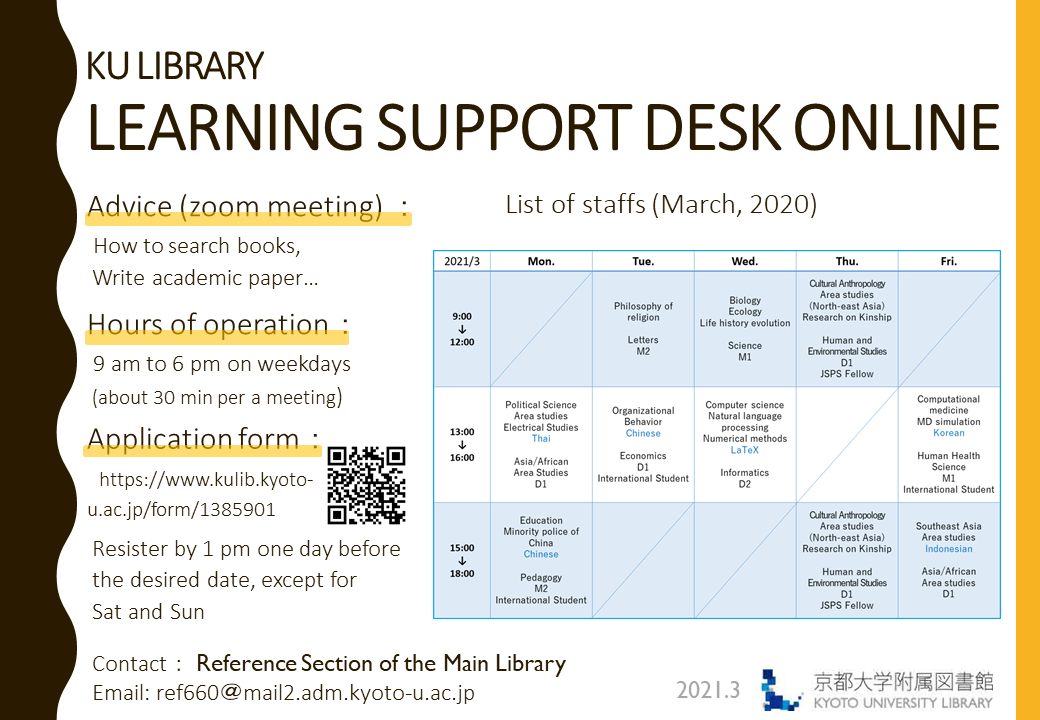
    6. The counseling service at the Study Support Desk will be suspended.

    We ask users visiting the library to:

      • Wash your hands frequently.
      • Avoid closed spaces where ventilation is poor and crowded places.
      • Avoid close contact with other individuals; hold conversations from a distance of at least each other’s arm’s reach.


    [Information added on March 27, 2020]

    Additional measures starting March 31, 2020

    Starting Tuesday, March 31, 2020, the Main Library will implement the following additional measures to prevent the spread of the novel coronavirus and maintain our students’ study environment.

    1. Users should not be seated next to each other.

          • Do not use the desk space with the sign “Unavailable” to keep distance from other users.
          • Please consider for other users and do not hold a seat by leaving your bag.
          • While the library staff continue to clean the facilities, please wash your hands frequently and cooperate in opening windows to let fresh air in.

    2. The Study Room 24 will be closed at 22:00 on weekdays from April 1, 2020 until further notice. (There is no change on weekends and holidays.)

    3. The following areas will be open for the purpose of self-learning, meaning conversations with other users are not allowed.

    1st FloorNagomiclosed at 22:00 on weekdays / eating is not allowed
    1st FloorLearning Commonsclosed at 22:00 on weekdays
    3rd FloorLibrary Hallclosed at 21:30 on weekdays / irregularly close
    3rd FloorCommon Study Room 5closed at 21:30 on weekdays
    3rd FloorStudy Cubiclesclosed at 21:30 on weekdays

    4. Admission to the library will be suspended for users with a library card for a graduate.

    5. The number of items you can borrow and the time to extend the borrowing period will be increased.

          • You can borrow up to 10 items from the open shelves, so that you can study home.
          • You can also extend the borrowing period five times for items from the open shelves and two times for items from the stacks, unless they are reserved by other users.


    [Information added on March 17, 2020]

    Rare/semi-rare materials service suspension

    The Main Library suspends the use of all the materials stored in the rare materials storage and the semi-rare materials storage, including dissertations and Kanpō (Japanese government gazette), effective from March 18, 2020 until the day to be determined.


    [Information added on March 6, 2020]

    Special measures concerning the due dates of library materials you have borrowed

    (1) Users with the library cards (student ID cards) that expire on or after April 1, 2020

    Due dates for books originally on or after March 3, 2020 are extended to April 15, 2020.
    Please note that journals should be returned by the original due dates.

    *How to check the expiration date of your library cards
    -Check the date printed on the cards (see Types of library cards).
    -Using MyLUNIE. You can also check your due dates for books.
    -Ask us by e-mail: User Support Division, Kyoto University Main Library unyou660@mail2.adm.kyoto-u.ac.jp

    (2) Users who belong to Kyoto University after April but have the library cards (student ID cards) that expire on or before March 31, 2020

    Please contact the Main Library in order to extend the due dates as stated above (1).

    (3) Users who leave Kyoto University after April and have the library cards (student ID cards) that expire on or before March 31, 2020

    Due dates are not extended. Please return library materials by the original due dates by visiting the library or sending them back by postal mail or other delivery services.

    (4) How to return books by postal mail or other delivery services

    Books and journals held by Kyoto University Main Library (excluding library materials held by other libraries) can be returned by postal mail or other delivery services.

    Sending Address:
    User Support Division, Kyoto University Main Library
    Yoshida Honmachi, Sakyo-ku, Kyoto 606-8501, Japan
    TEL 075-753-2632

        • Pack the library materials appropriately so that they are not damaged in transit.
        • Specify on the package that library materials are inside.
        • Users are to pay the delivery fee.
        • Keep the copy of the delivery invoice in case of accidents.


    [Information posted on March 3, 2020]

    In order to prevent COVID-19 from spreading within the facilities, Kyoto University Main Library implements the following measures.

    PERIOD: From March 4, 2020 until the date to be determined

        1. Those suspected to be infected are not admitted to the library.
          We also ask those with symptoms typically caused by COVID-19 to refrain from visiting the library.
          The symptoms include fever, cough, sneezing and fatigue.
        2. Admission to the library is limited to Kyoto University members (including graduates and retired faculty and staff) only.
        3. Common Study Rooms, Study Cubicles, Media Commons, Media Theater and Learning Commons are closed.
          Although study counseling at the Study Support Desk is available, users are required to wear masks.
        4. Please cooperate in measures against infectious diseases including COVID-19.
          • Wash your hands
          • Wear a mask
          • Keep a distance from other users in the reading rooms

    Kyoto University Main Library’s opening hours are currently not changed and Study Room 24 is available.
    However, we may change the opening hours or close the facilities depending on the situations.
    Please check the latest updates on our website.

    REFERENCES:
    Kyoto University’s Policy on the Novel Coronavirus (COVID-19) (Ver. 4)
    Measures against Infectious Diseases(Ministry of Health, Labour and Welfare, Japan)


    [Main Library User Support Division]


    [Library Network] Kyoto University Rare Materials Digital Archive: Main Library’s 289 items from Nakanoin Collection and Konoe Collection have been released

     On 2020-03-19 (4085 reads)

    A total of 289 items – 278 items from Nakanoin Collection and 11 items from Konoe Collection held by the Main Library – have been newly digitized and released. Kyoto University Rare Materials Digital Archive provides 1,363,600 images of 17,638 titles as of March 19, 2020.
     

    ▼Nakanoin Collection

    Nakanoin Collection was formerly owned by Count Michinori Nakanoin (1856-1925), from whom former President of Sumitomo Company Kichizaemon Sumitomo, who was related to the Nakanoin Family by marriage, purchased 1,041 books of the collection and donated them to Kyoto University Library in 1923. The count’s family tree goes back to Murakami-Genji and in particular, the 14th family head Michikatsu (1558-1610) and Michimura (1588-1653) contributed to the development of Japanese literature. Most items of this collection are handwritten by the family members themselves or copies by hand of such manuscripts, as well as books owned by the Nakai family. They include annotations to imperial-commissioned poem anthologies, Genji Monogatari and Ise Monogatari, diaries and memoranda on ceremonies and rituals in the Imperial court. These are valuable primary sources in the research of the situations in the Imperial court and ordinary people’s lives at the time.

    中院通繋記 御元服雑記/享保三年(中院文庫)

    中院通繋記 御元服雑記/享保三年(中院文庫)

    ▼Konoe Collection

    The original Konoe Collection was formerly held by the Konoe Family, the leading family of the five regent houses. The Konoe Family had deposited books that had been passed down through the family with Kyoto University on several occasions since 1900. In 1938, however, in order to secure the preservation of this precious collection, a public interest incorporated foundation, Yomei Bunko was founded and the books in care of Kyoto University until then were returned to the Konoe Family and were then incorporated into Yomei Bunko. In this process, 3,150 volumes of 219 titles among the previously deposited books were donated to Kyoto University Main Library and became the library collection currently called Konoe Collection. The major part of the collection is Chinese classics including renowned “荘子鬳齋口義”, “欒城集” and "雲南通志", but it also includes old manuscript copies of Utsuho Monogatari, Ochikubo Monogatari and Okagami, as well as Kokatsuji-han (old type editions) created in Japan during the former half of the 17th century such as “医学入門”, “古今医鑑”.

    中院通繋記 御元服雑記/享保三年(中院文庫)

    文渕(近衛文庫)

    The Main Library of Kyoto University takes part as a core university in the "Project to Build an International Collaborative Research Network for Pre-modern Japanese Texts (NIJL-NW project)" led by the National Institute of Japanese Literature, which supports the digitization of the 289 books released this time.


    [Library Network] Kyoto University Rare Materials Digital Archive: 1848 items of “Asia depicted on Postcards” donated to the Main Library have been released

     On 2020-03-19 (5679 reads)

    1848 items of “Asia depicted on Postcards” donated to the Main Library have been released.
     

    ▼Asia depicted on Postcards

    “Asia depicted on Postcards” is a collection of postcards related to Asia that a group of researchers led by Prof. Toshihiko Kishi of the Department of Political and Economic Coexistence, the Center for Southeast Asian Studies, Kyoto University (CEAS) have gathered since 2004. Among these, 1848 postcards and their digital images were donated to the Main Library.

    Postcards include not only images but also characters and codes, and sometimes even sounds and moves (with movable parts) and thus have a characteristic of mixed media that stimulates the imagination of their viewers. On the other hand, images on postcards created, censored and sold in Imperial Japan also reflect the intention of their creators, distributors, printers and censorship agencies, which gives them great significance as historical records. This collection’s postcards cover a wide range of areas, such as Japan, China, China (Mongolia), China (Manchuria), Hong Kong, Taiwan, the Korean Peninsula, Southeast Asia, Soviet Union/Russia, Sakhalin, and the Pacific Ocean.

    Old Parliament House, Bangkok (currently the Ananda Samakhom Throne Hall)

    Old Parliament House, Bangkok (currently the Ananda Samakhom Throne Hall)


    Solved:[Trouble]Oxford University Press E-Journals & E-Books(Access Error)

     On 2020-03-09 (3561 reads)

    (2020/03/10)
    This problem was solved.
    If that doesn't work, please clear your browser's cache.
    ref. How to clear the cache?
      http://www.iimc.kyoto-u.ac.jp/en/faq/general/general/post_159.html

    --------------------------------------------

    (2020/03/09)

    An access error occurred in the e-journals and e-books published by Oxford University Press.

    • E-Journals published mainly in 2020.
    • E-Books provided on the following platforms.
      • University Press Scholarship Online
      • Oxford Scholarly Authorities on International Law etc.

    When you try to access to the full-text, "Purchase" message is displayed and you cannot get anything.

    We will post a message when the problems have been resolved.
    We apologize for any inconvenience this may cause you.

    [Kyoto University Library Electronic Resources Section]


    [Library Network] Kyoto University Rare Materials Digital Archive: 1,067 items from Nakai Collection's Kinri-no-bu newly released

     On 2020-02-21 (4428 reads)

    One thousand sixty-seven items from Nakai Collection's Kinri-no-bu have been newly digitized and released. As of February 21, 2020, Digital Archive provides 1,342,116 images of 15,448 titles.

    Nakai Collection's Kinri-no-bu

    京都皇居色別指圖
    京都皇居色別指圖

    Kinri-no-bu (禁裏之部; Imperial Palace) of Nakai Collection is composed of 1,067 items, including architectural plans of each residence in Kyoto Imperial Palace such as Shishin-den (紫宸殿; Hall for State Ceremonies), Seiryo-den (清涼殿; Emperor's Habitual Residence) and Sento-gosho (仙洞御所; Sento Imperial Palace), drawings of each part of the buildings, ornament and other equipment, and registers of restoration. The variety of records in type and content tells us the essence of Japanese architectural technique that has been passed down in Kyoto Imperial Palace today.

    Architectural plans include ground plans, cross-sectional views, elevation views and okoshi-ezu (起こし絵図). Okoshi-ezu has both functions of a building model and architectural plans and is suitable to visualize a small building with complicated components. Carpenters during the Edo period often used this method.

    These materials were digitized and released in the digital archive under the Kyoto University President-Selected Project “Digitization and Internet-release of Treasure of Kyoto Kinri-no-bu, Nakai Collection held by the Main Library of Kyoto University”. Large-sized illustrated plans were digitized by using a no-contact, ultra-high resolution scanner. The scanner ran over a plan along the frame set around it, producing strips of digital images, which were then merged into one entire image.