Learn More about KURENAI
KURENAI Provides Open Access
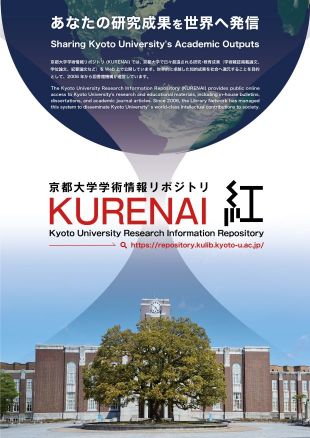
Open access is a growing international trend that makes academic research freely available. Kyoto University Research Information Repository (KURENAI), is a platform that provides open access to research and educational outputs of Kyoto University, making contribution to broader communities.
- Repository contents will also be included in databases such as Google Scholar and CiNii.
- Permalinks are provided to ensure permanent access.
What is KURENAI?
KURENAI is an acronym for Kyoto University Repository for Navigating Academic Information. The name KURENAI recalls the opening lines of the anthem of Japan's Third High School, an antecedent of Kyoto University.
Japan's largest repository
Since the launch in 2006, KURENAI has been increasing the numbers of both outputs and the access to them. KURENAI became the largest institutional repository in Japan and ranked 6th in the Rankings of World Web Repositories hosted by the Consejo Superior de Investigaciones Cientificas (CSIC; Spain: May 2025).
- Aguillo, Isidro F. (2025). Transparent Ranking of Repositories 2025. figshare. Preprint. https://doi.org/10.6084/m9.figshare.29099234.v2
- Content Statistics for KURENAI
Copyright of the Contents in KURENAI
Copyright of the contents in KURENAI belongs to the authors or the publishers of the contents, not to the Kyoto University Library Network.
- If the "Rights" (dc.rights) field is provided in the metadata: Please use the content in accordance with the specified rights information or the Creative Commons license.
- If the "Rights" (dc.rights) field is NOT provided in the metadata: Content is only for private use or citation as permitted by Copyright Law.
For any use exceeding these limits, users must obtain permission from the copyright holder(s) directly.
Time Stamping Service
Since April 2026, KURENAI has introduced a time-stamping function that utilizes the Time Stamping Service provided by the National Institute of Informatics (NII) to enhance the reliability of published papers and data. With this feature, it is possible to prove "when the content was registered" and "that it has not been modified since registration," allowing for the external demonstration of file integrity.
What is a Time Stamp?
A time stamp is an "electronic postmark" applied to digital files. Just as a physical postmark proves that a post office received a letter on a specific date, a time stamp proves that "this digital file existed at this date and time and has not been changed since then." A time stamp can prove the following two points:
- Proof of Existence: A third-party organization certifies that the content existed at the time of the postmark.
- Proof of Non-tampering: A third-party organization certifies that the content has not been altered at all from the time of the postmark to the present.
How Time Stamps are Applied
Time stamps are automatically assigned by the system at the time of content registration in KURENAI.
- Time stamps are assigned to contents registered in KURENAI from April 2026 onwards.
- If you modify and replace content that has already been registered, the time stamp will be updated to the time of re-registration.
How to Verify
- On the KURENAI item screen, click the [Verification URL] located to the right of the file name.
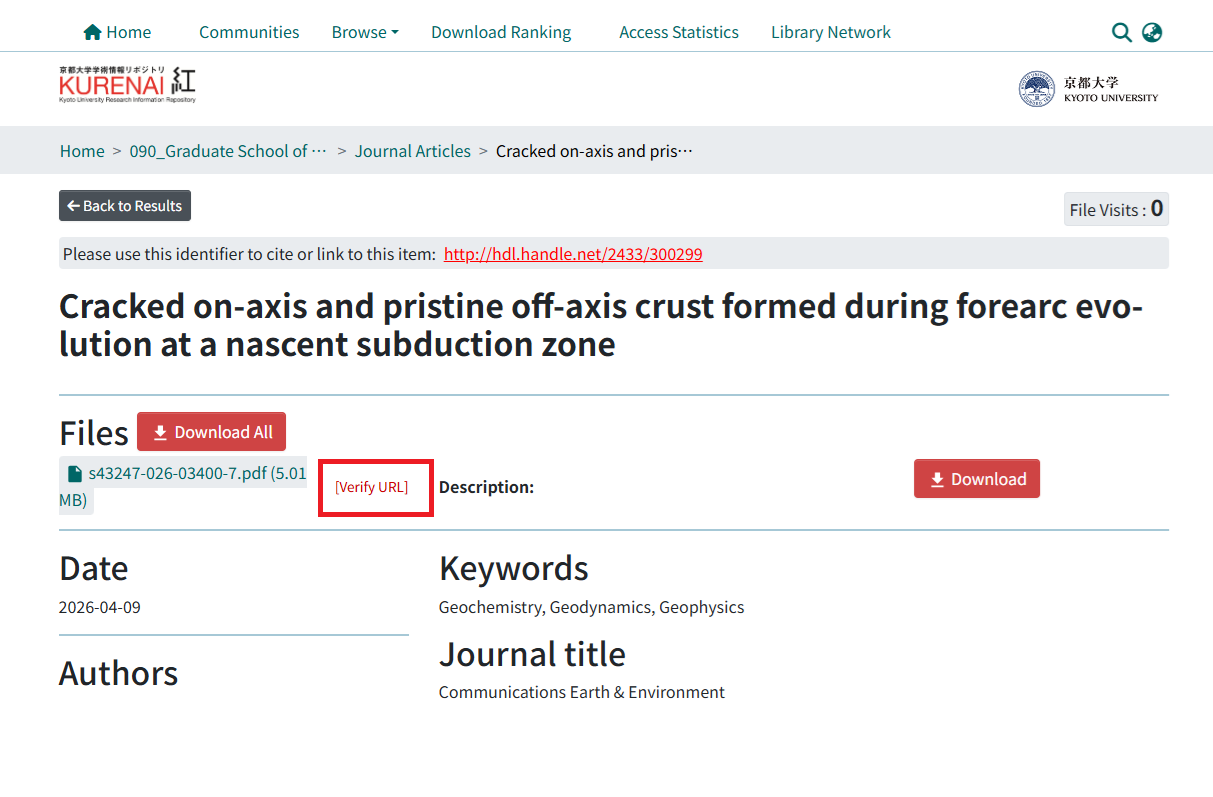
- The verification result screen will appear, displaying the authenticity in real-time.
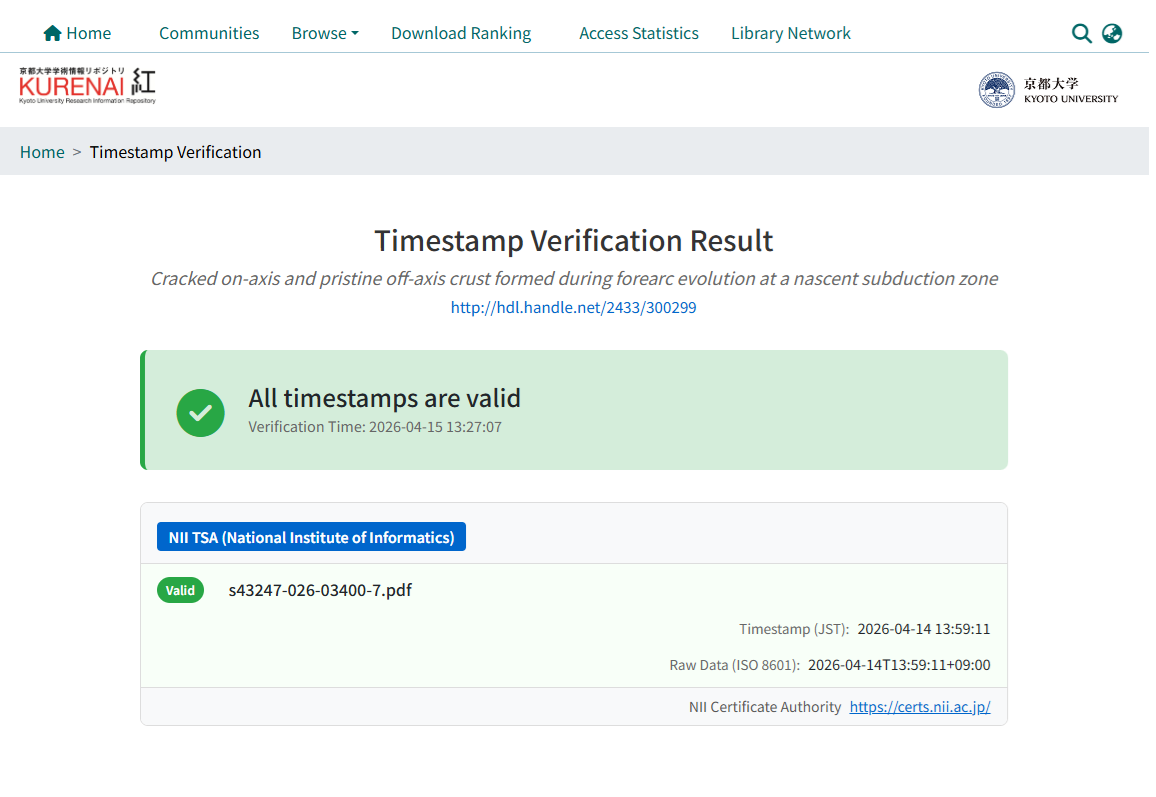
How Time Stamping Works
The time-stamping process consists of [1] Request, [2] Issuance, [3] Storage, and [4] Verification with a Time Stamping Authority.
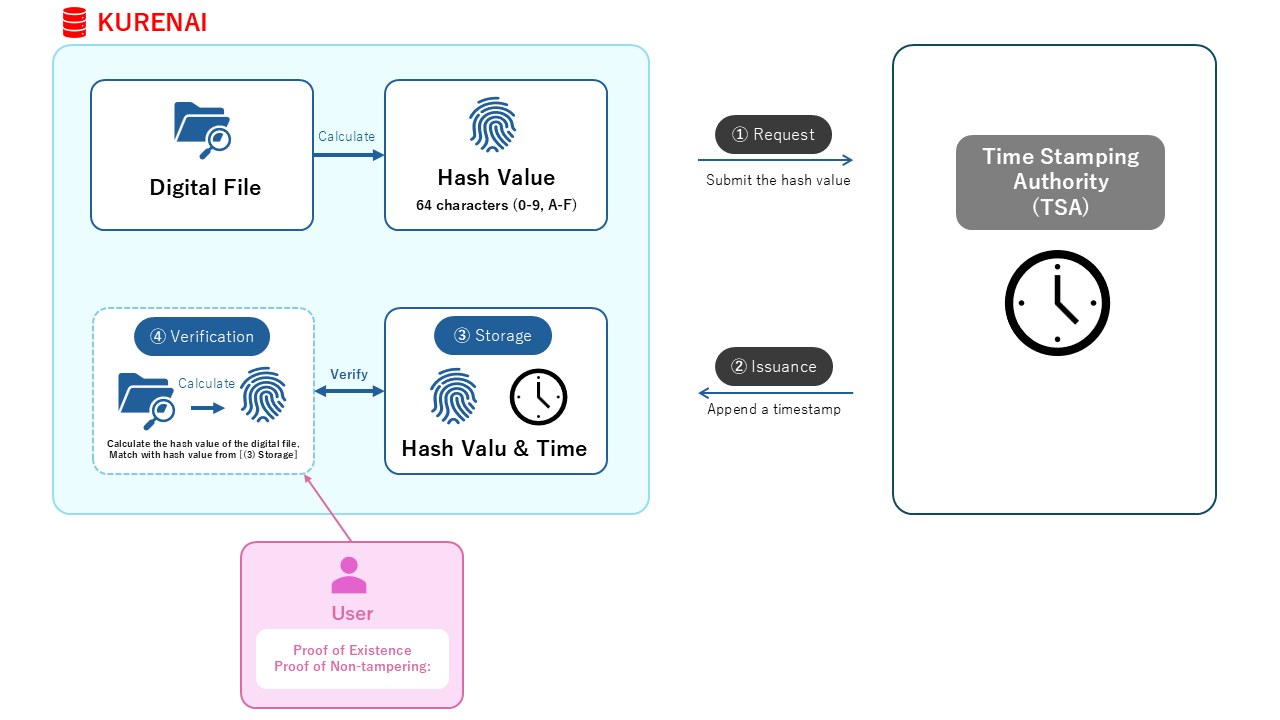
- Request: The hash value of the digital file (equivalent to a digital fingerprint) is calculated and sent to the Time Stamping Authority.
- Issuance: The Time Stamping Authority issues a token containing the hash value combined with the current accurate time.
- Storage: The issued time stamp is stored in KURENAI.
- Verification: The hash of the original digital file is recalculated; if it matches the time stamp in [3], it proves that no modifications have been made.
KURENAI utilizes the Time Stamping Service of the National Institute of Informatics (NII) as its Time Stamping Authority. For more details, please see the following page:
UPKI Manual: Time Stamp Usage Information (Japanese)
Operating Structure
KURENAI is operated by the Kyoto University Library Network.
Benefits of Publishing Articles and Journals on KURENAI
We asked the faculty members at Kyoto University about the benefits of making articles and journals open access on KURENAI.
- Voice of Researchers: Benefit of Publishing Articles on KURENAI
- Special Event: Interview to Prof. Hajime Kita
- Voice of Publishers: Benefit of Publishing Journals on KURENAI
The Kyoto University Open Access Promotion Project (2016–2021)
In order to realize the "WINDOW: A Vision for the Future," Kyoto University has launched the "Kyoto University Priority Strategic Action Plan (2016–2021)" focusing on the third mid-term objectives. As part of the plan, the Kyoto University Library Network has been carrying out the "Open Access Promotion Project" to implement the "Kyoto University Open Access Policy."
The "Open Access Promotion Project" aims to promote open access to research results of our faculty members and rare materials we hold and to enhance our research support capabilities.
Archive on the "Kyoto University Open Access Promotion Project (2016–2021)"
